
30. 03. 2025
The “State of play of green finance in European regions”: key findings of IE project GreenGov initial study
GreenGov study has found that public authorities are becoming increasingly familiar with the EU Taxonomy. Authorities are beginning to incorporate the Taxonomy's Technical Screening Criteria in specific sectors (urban planning, economic recovery, sustainability plans, etc), although the depth of their understanding can still vary significantly.
The IE project GreenGov’s initial study on the “State of play of green finance in European regions”, conducted by E&Y, was presented to the project partners on November the 26th in Craiova (Romania), during the project’s 2° Consortium meeting, and is now publicly available on GreenGov website (Part 1, Part 2).
On the one hand, the study aims to provide an overview of green finance regulatory issues and the EU taxonomy, while exploring the main challenges for regional and local authorities. On the other hand, it proposes recommendations to improve the implementation of green finance tools and strategies, focusing on GreenGov topics: EU Taxonomy and DNSH, climate proofing of infrastructure, green bonds, green budget and financial instruments to support SMEs ecological transition.
The EU green finance regulatory framework
The study reports that, from a regulatory standpoint, EU sustainable finance instruments and rules can be organized according to their objectives and regions’ competencies:
- Instruments that have a role in implementing the transition through public policies: for instance, using the EU taxonomy to enhance (or assess) the "greenness" of public policies.
- Issuing green bonds in the markets by using the same tools as businesses: regions can present themselves favourably to investors by issuing bonds. As public authorities investing in some types of infrastructure (e.g., transport infrastructure), these regional bonds could much more likely align with the EU Taxonomy.
- Leveraging sustainable finance tools to structure the criteria for other policy instruments: for example, using the Do No Significant Harm (DNSH) principle when financing a project that may not have a green objective, to ensure Environmental, Social, and Governance (ESG) risks are effectively managed, could constitute a responsible approach.
In practice, regions are becoming increasingly familiar with sustainable finance tools, though there are still topics less implemented/used than others. For instance, while green budgeting practices are increasingly seen in Europe at regional or local levels, emerging in varying forms, the implementation of the EU Taxonomy in a comprehensive way is still blurred with the segmented use that is made of it. “While awareness is growing, there is still significant room for improvement in the understanding and implementation of these critical sustainability concepts among public authorities”, explains Natixis GSH (Green and Sustainable Hub | Natixis CIB Finance Climate Transition ESG) public sector experts.
Implementing good practices of green finance: challenges and positive impacts
Based on a survey submitted to 11 European Authorities and a literature analysis, the study has also identified 16 good practices. In these practices, the challenges observed are:
- the lack of availability and quality of data required for accurate assessments (e.g. for the implementation of DNSH and climate proofing analysis).
- Limited resources and internal expertise.
- The difficulty of gathering and managing sustainability information, involving multiple stakeholders across different sectors (e.g. dealing with both finance and climate/environment departments).
- The complex and evolutive nature of the regulatory frameworks (e.g. the EU Taxonomy).
- the administrative burden for SMEs willing to get public support.

On the other hand, the positive impacts observed are:
- the enhancement of regional governance context by:
- the promotion of multi-stakeholder involvement, encouraging both collaboration among local communities and internal dialogue between the administrations.
- the promotion of internal or external dedicated bodies to oversee the implementation of frameworks.
- The enhancement of accountability, transparency, and investors’ confidence by providing a clear set of criteria for evaluating projects.
- Mainstreaming environmental goals and concerns into financial cycles.

GreenGov recommendations for EU regional Authorities
The study’s overall recommendations for the implementation of sustainable finance tools reveal a strong emphasis on transparency, stakeholder engagement, and structured governance. They are designed to inspire and guide other European regions to foster and improve green finance implementation and include:
- enhancing governance
- engaging stakeholders
- fostering transparency
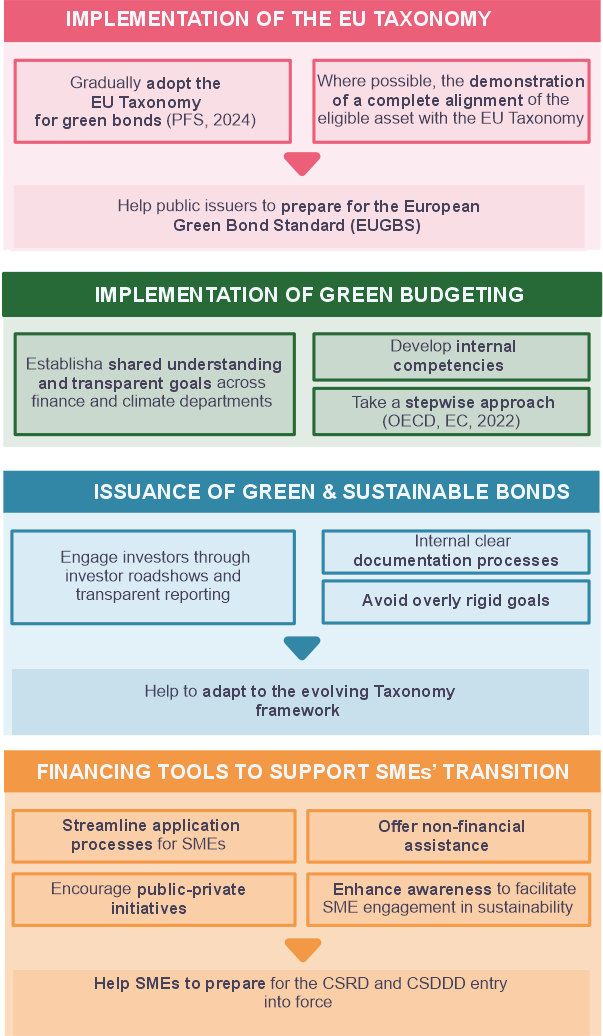
The study recommendations are summarized in the “GreenGov Initial Study Factsheet”.
Moving from the publication of this study, GreenGov’s interregional knowledge exchange activities will now carry on by focusing on the specific recommendations addressed to the project partners about the project topics.