28. 04. 2026
Author: Nela Kadlečíková
How do we actually incorporate climate and environmental goals into organizational budgets today?
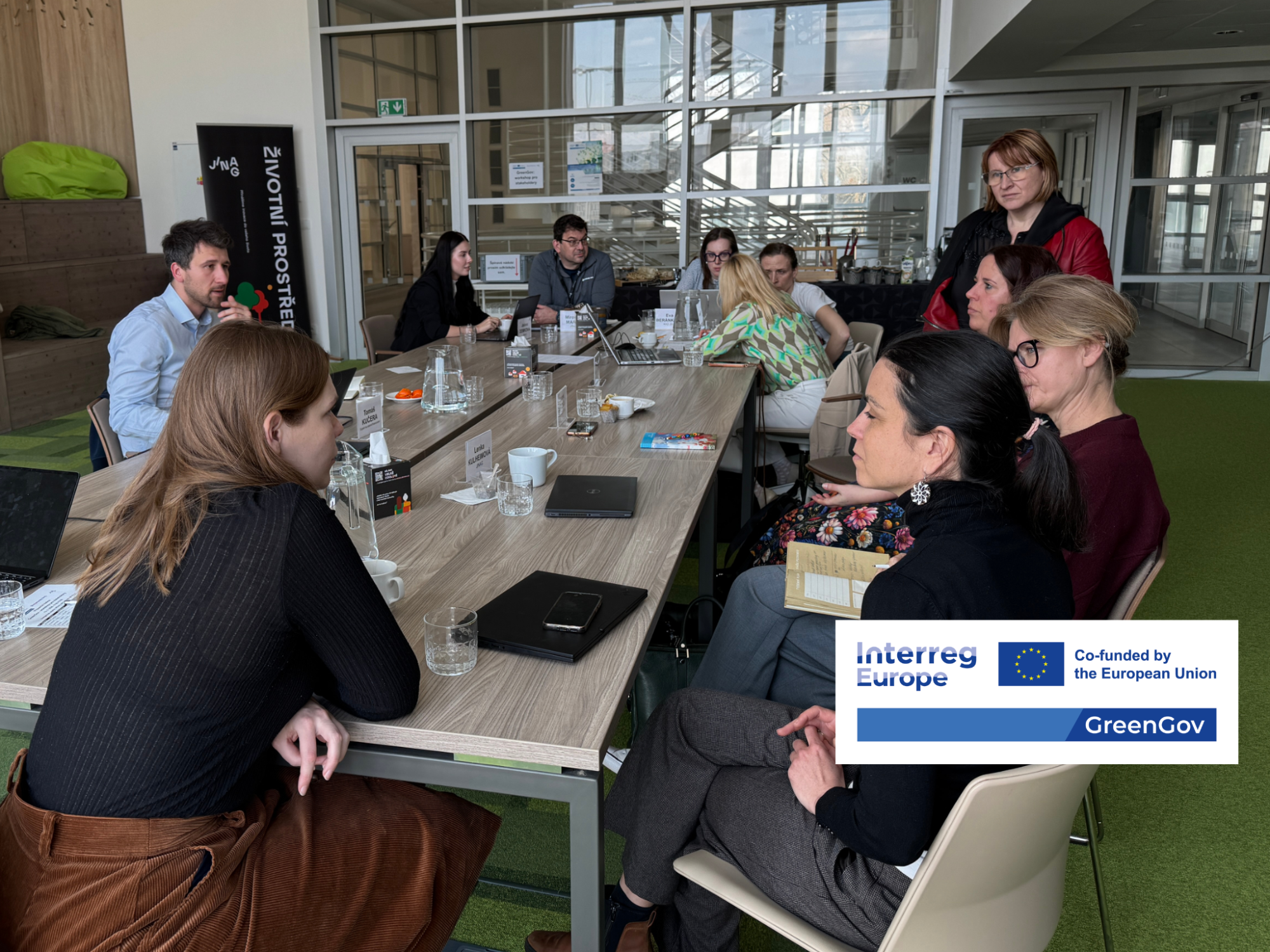
As part of the GreenGov project, we’ve addressed a topic often overlooked: how to effectively link public finances to climate and environmental goals. We explored how budgetary tools can help translate strategic goals into real-world practice together with stakeholders from Mendel University, Masaryk University, Brno University of Technology, the University of Defence, the South Moravian Regional Authority, and JIMEG during two workshops we organized in March and April.
Focus on performance-based budgeting with an environmental perspective
We explored how to link expenditures to specific outcomes and how to systematically integrate environmental goals into the budget framework. It was repeatedly noted that without clearly defined indicators and a firm link to the budget, climate commitments tend to remain mere declarations. Performance-based budgeting thus serves as a vital bridge between strategy and actual implementation.
Focus on Green Budgeting
At the second workshop, we focused on how to directly integrate climate and environmental perspectives into budgetary processes. International approaches were presented, such as environmental labeling of expenditures, ex-ante assessments of new budgetary measures, and ex-post evaluations of the impacts of public finances.
What we learned from the workshops
Both workshops demonstrated that the key shift is not merely to “add a green layer” to budgets, but to systematically address the full spectrum of public spending impacts—both positive and negative—including environmentally harmful subsidies or investments lacking appropriate criteria.
Furthermore, the workshops revealed that performance-based budgeting and green budgeting complement each other. The former helps track what we get for our money, while the latter adds the question of what impact it has on the climate and the environment.
It was strongly emphasized that without clearly defined goals and a strategic foundation (e.g., the South Moravian Region’s Action Plan for Climate Change or an institutional sustainability strategy), even advanced tools remain limited and their impact is lost.
Another important conclusion is that change rests on three steps: identifying problematic expenditures, assessing new proposals before they are approved, and subsequently monitoring their actual impact. Only the combination of these steps makes sense.
At the same time, it is clear that this is not just about methodologies. Data, human capacity, and ensuring that these approaches are truly integrated into everyday decision-making are also key. Otherwise, there is a risk that they will remain merely in reports and tables.
Experience from other countries confirms that there is no single correct model. Whether the system is centralized or decentralized, it works only when green budgeting is an integral part of the budgeting process itself, not merely an add-on.
We thank everyone involved for the open discussion. It is precisely thanks to this discussion that we are able to move sustainable financing from theory to practice.
The GreenGov project is co-financed by the Interreg Europe program.