11. 03. 2026
Author:
Working groups Settlements and Landscape: seeking solutions for a more resilient region
How can we ensure that the landscape and towns of the South Moravian Region can cope with the effects of climate change? The answer does not lie in a single institution or discipline. It arises from cooperation between scientists, public administration, strategic and territorial experts, landscape managers, and organizations with practical experience.
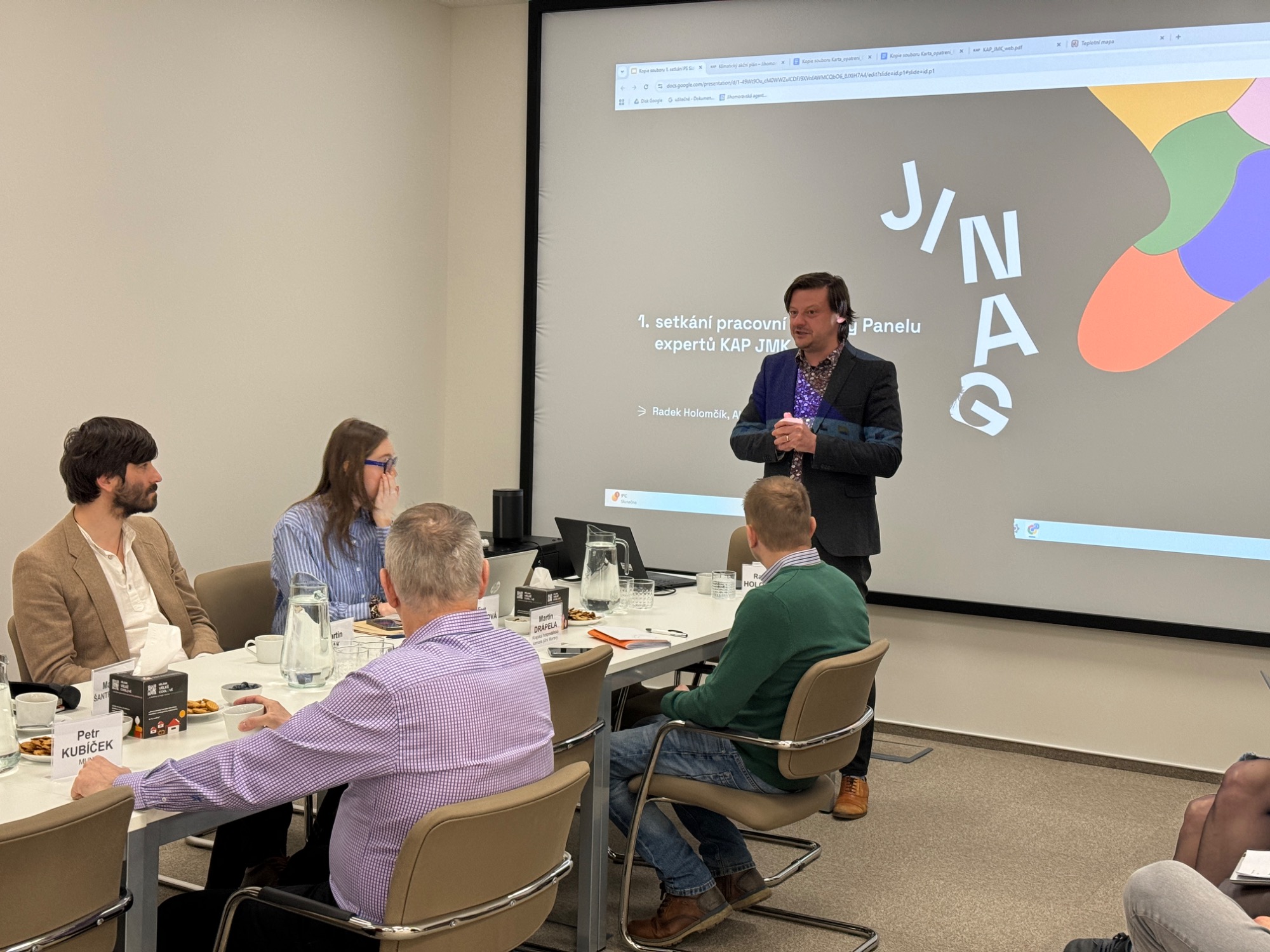
Two meetings were held within the working groups of the Expert Panel of the South Moravian Region Climate Action Plan (CAP SMR), one with the Settlements working group and the other with the Landscape working group. The discussion showed that the issues of urban overheating, water management, and soil quality are closely interlinked and require a coordinated, interdisciplinary approach.
Urban heat islands and health impacts
One of the main topics of the Settlements working group meeting was the impact of climate change on human health—a priority topic for the first implementation period of the CAP for 2026. Children, seniors, and people who work outdoors for long periods of time are particularly vulnerable, but experts emphasized that the measures proposed for these groups ultimately improve the quality of life for everyone. The impact of climate on health will be discussed in more detail at a roundtable (organized by JINAG) to propose specific measures. The working group provided many important thematic inputs for this follow-up round table.
There was also a presentation on the BeReady project, which focuses on urban heat islands and the identification of the most vulnerable locations.
How to put science into practice
Part of the debate focused on how to transfer expert knowledge into municipalities' and institutions' decision-making processes. JINAG is therefore developing the concept of a "knowledge region" to link research with practical implementation. One of the tools is innovation brokering, which helps municipalities find expertise, data, and technological solutions to address specific challenges in the area.
The experts agreed that it is crucial to move away from purely sectoral thinking and seek solutions that deliver multiple benefits simultaneously, such as cooling cities, retaining water, and supporting biodiversity.
Landscape as the basis for regional resilience
As part of a working group focused on landscape and its ability to respond to climate extremes, Jakub Houška from the Landscape Research Institute gave a presentation on the Czech Republic's landscape policy and landscape planning methodology. He outlined the main reasons for creating this strategic approach, which aims to link existing national strategies on landscape use and protection and to set long-term landscape management priorities until 2050. The presentation also showed how systematic landscape planning can improve water retention, protect biodiversity, and support sustainable landscape management. One of the goals of CAP is to prepare a Landscape Plan for the South Moravian Region and, in the future, for each municipality, ideally through participatory methods that involve citizens in the plan's preparation.
The discussion showed that ownership relations, economic motivations, and insufficient or missing legislation are major issues. Implementing measures often requires cooperation among municipalities, farmers, and private owners. Without appropriate compensation or support, some measures are difficult to enforce.
Maintaining measures already implemented, such as new wetlands, tree plantings, or landscape features, also plays an important role.
Common denominator: cooperation
One theme recurred across both working groups, namely the need for cooperation and coordination, as climate measures affect spatial planning, nature conservation, water management, health care, and education.
The expert panel, therefore, creates a space where these worlds can meet and seek common solutions. The aim is not only to share information, but also to identify specific projects, pilot measures, and systemic barriers that need to be overcome.
Resilient landscapes and prepared cities do not arise on their own. They are the result of long-term cooperation, quality data, and smart decisions. The CAP SMR expert panel is one of the tools for systematically developing this cooperation in the region.
The Working Group on Settlements consists of:
- Agency for Nature Conservation and Landscape Protection of the Czech Republic
- CzechGlobe, Global Change Research Institute of the Czech Academy of Sciences
- People in Need
- Janáček Academy of Music and Performing Arts in Brno
- JINAG, South Moravian Agency for Public Innovation
- South Moravian Regional Chamber of Commerce
- South Moravian Regional Authority
- Masaryk University in Brno
- Mendel University in Brno
- Partnership Foundation
- Brno University of Technology
- Research Institute of Melioration and Soil Protection, v. v. i.
- Research Institute for Landscape, v. v. i.
- T. G. Masaryk Water Research Institute, v. v. i
The Landscape Working Group consists of
- Nature Conservation Agency and Landscape Protection of the Czech Republic
- CzechGlobe, Global Change Research Institute of the Czech Academy of Sciences
- JINAG, South Moravian Agency for Public Innovation
- Coordination Center of Local Action Groups
- Regional Office of the South Moravian Region
- Forests of the Czech Republic
- Lipka – educational facility for environmental education
- Masaryk University in Brno
- Mendel University in Brno
- Czech Environmental Partnership Foundation
- Morava River Basin
- Road Administration and Maintenance of the South Moravian Region
- State Land Office
- Research Institute of Melioration and Soil Protection, v. v. i.
- Research Institute for Landscape, v. v. i.
- T. G. Masaryk Water Research Institute, v. v. i.