19. 02. 2026
Author: Zuzana Novotná
The expert panel has begun its work. We are starting with participation and communication
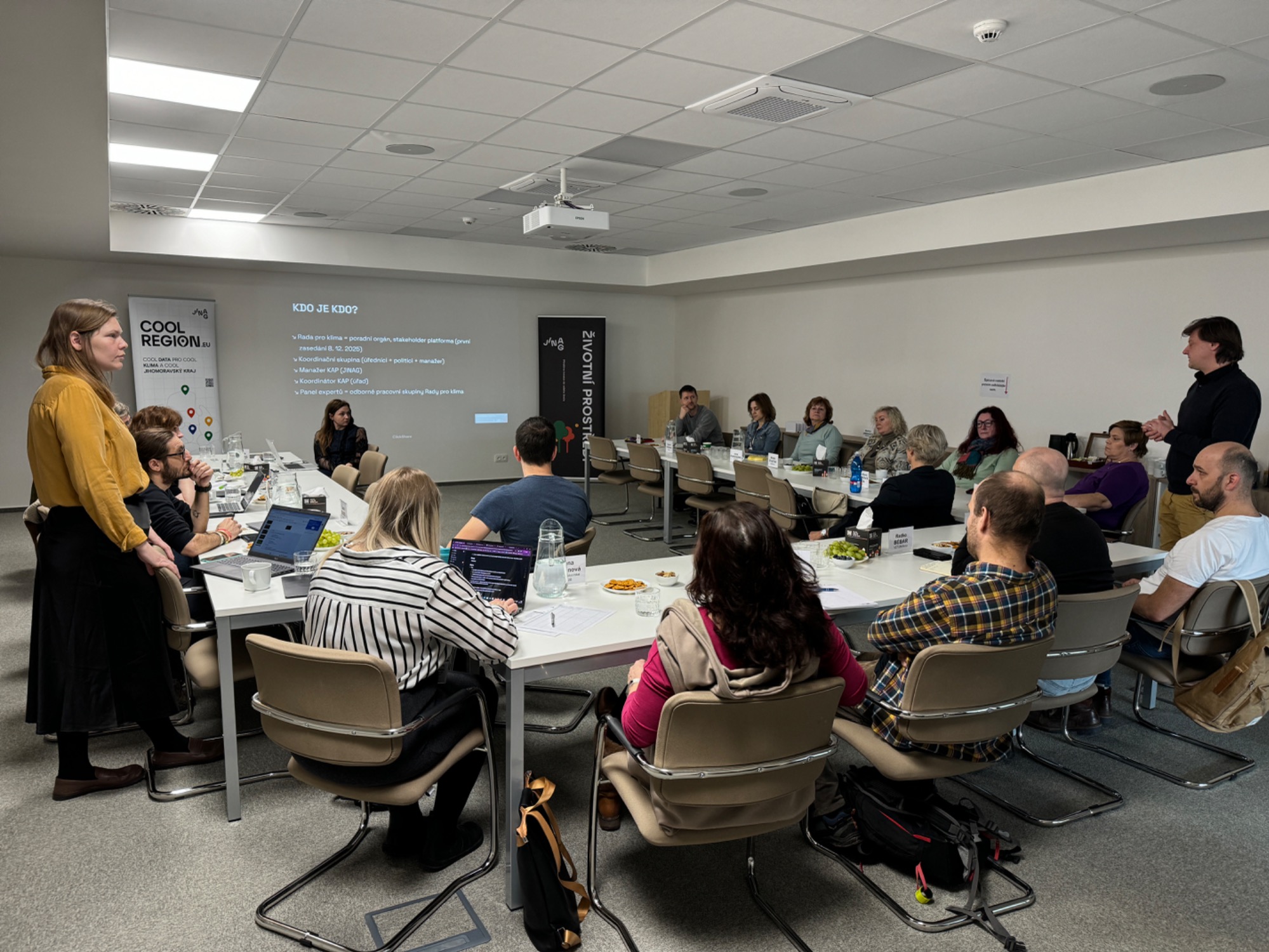
On February 12, 2026, the first meeting of the Expert Panel working groups focused on participation, awareness, and communication in the implementation of the South Moravian Region Climate Action Plan (KAP JMK) took place at the Kongresák space in Brno. The meeting opened a new phase of cooperation aimed at strengthening public and local actors' involvement in climate measures – not just formally, but genuinely and in the long term.
Participation as a prerequisite for successful transformation
The goal of the Participation and Awareness area is ambitious but clear: by 2030, the public in the South Moravian Region will not only accept adaptation and mitigation measures, but will actively support and develop them, aware of their benefits for themselves and for society as a whole.
This means that climate measures are not a "government project" but a joint effort by municipalities, institutions, schools, companies, and citizens. When deciding on their implementation, the voices and needs of all those affected must be heard so that the changes reinforce a sense of influence and shared responsibility.
Managing cooperation, not institutions
The implementation of the KAP JMK is based on a principle that was repeatedly emphasized at the meeting: the KAP is not a "regional plan," but a framework for cross-sector cooperation.
The South Moravian Region does not act as an authority here, but as one of the actors. The inspiration is the cooperation model known from the Regional Innovation Strategy of the South Moravian Region, where coordination, information sharing, and respect for the autonomy of individual institutions are key.
The panel of experts is therefore not a formal advisory body, but a working and partnership platform intended to deliver concrete proposals, reflections on practice, and support for the implementation of activities in the region.
What did the first meeting, which focused on participation and communication, bring?
The participants openly discussed the role the group should play in implementing the KAP JMK. They agreed that its contribution does not lie in formal comment on documents, but in actively providing expert and consultative support for implementation, co-creating specific activities, and sharing field experiences. Another important part of its role is to identify barriers to participation in the region, whether they relate to municipal capacities, public communication, or trust among actors. It was noted that the working group should operate flexibly, with clearly defined lines of work and a real link to the Climate Council and other thematic working groups, so that its work has a concrete impact.
One of the main topics was the preparation for the KAP JMK regional roadshow, intended to activate the region in 2026, work with municipalities, and share good practices. The discussion focused on what would be most beneficial to municipalities – whether it should be primarily inspiration and examples of good practice, practical tools and methodologies, or a space for open sharing of problems. There was agreement that an isolated approach does not work. Municipalities need a combination of inspiration and concrete tools, as well as a safe space for sharing experiences. It is crucial that the format is not based on one-sided presentations but allows for interaction and active participation of attendees.
Part of the setup is also to continuously show what is working: to publish progress in the implementation of climate measures in a comprehensible manner each year and to link this to invitations to get involved. This will allow people to see how the measures are being implemented and how they themselves can contribute. Communication thus becomes not only a source of information, but also a practical tool that reduces conflict, motivates action, and gradually makes sustainable measures a natural part of everyday life in the region.
The first meeting was mainly a start to jointly fine-tune roles and find ways to move the climate and society forward together.
The first meeting was mainly a start to jointly fine-tune roles and find ways to move the climate and society forward together.
Why do it together when activities already exist?
There are already a number of strong players in the South Moravian Region who are addressing climate issues. They implement high-quality programs, campaigns, and educational activities. The problem is not a lack of initiatives, but their fragmentation, uneven coverage of the territory, and often a lack of long-term strategic coordination.
Cooperation within the Expert Panel is not intended to replace or centralize these activities. Its goal is to create a framework in which individual initiatives can be linked, complemented, and strengthened. The new value should be, in particular, the coordination of topics and campaign timing, the sharing of data and evaluations, the joint setting of narratives and responses to myths, but also mutual learning between sectors. The Panel should enable field experiences to be more quickly reflected in regional strategies and, conversely, enable the region to systematically support what already works in the territory.
The first meeting of the Expert Panel did not produce a finished plan of activities or a clearly defined path to 2030. It was primarily an opportunity to meet, raise important topics, and begin clarifying the roles of individual partners. Climate transformation is not just a technical project but a long-term social process, which is why it will be crucial how we manage to cooperate, communicate, and involve other actors. The first meeting was therefore mainly a start to jointly fine-tune roles and find ways to move the climate and society forward together.
Climate Council and Expert Panel
The Climate Council provides advisory opinions to the authorities of the South Moravian Region on decisions regarding climate measures and policies. It approves the strategic framework, ongoing evaluations, and topic prioritization. It identifies directions and trends to focus on and initiates discussions on updating the South Moravian Region Climate Action Plan (KAP JMK). The Council expresses its opinions by consensus or vote and entrusts the KAP JMK manager with executive tasks.
The expert panel is composed of experts (individuals and companies) in the individual thematic areas of the Climate Action Plan of the South Moravian Region, who may be invited to participate in meetings or in other forms of cooperation with the KAP JMK implementation bodies. Their opinions primarily serve to assess the feasibility, effectiveness, and relevance of the proposed steps in implementing the KAP JMK.
Participation in the Council or Panel is voluntary, and members perform their duties without remuneration because they recognize the importance of cooperation in implementing the South Moravian Region Climate Action Plan. The working groups usually meet four times a year and collaborate on specific tasks between meetings as needed. The working groups are composed of representatives of municipalities, institutions, the non-profit sector, companies, and academia, who join based on their expertise and practical experience.
As of January 31, 2026, the Participation and Awareness Working Group consists of:
- CzechGlobe – Global Change Research Institute, Czech Academy of Sciences
- JINAG – South Moravian Agency for Public Innovation, an association
South Moravian Regional Authority - Lipka – Educational Facility for Environmental Education, Brno, contributory organization
- Brno City Municipality
- Masaryk University
- Mendel University in Brno
- Czech Environmental Partnership Foundation
- Veterinary University Brno
- VÚK – Research Institute for Landscape, v. v. i.
- VÚMOP - Research Institute for Soil and Water Conservation
- T. G. Masaryk Water Research Institute, v. v. i.
As of January 31, 2026, the Communication Working Group consists of:
- Lesy ČR (Forests of the Czech Republic)
- Masaryk University Brno
- Regional Association of NS MAS ČR of the South Moravian Region, p.s.
- Mendel University Brno
- Brno University of Technology
- JINAG - South Moravian Agency for Public Innovation, an association