01. 07. 2026
Author: Zuzana Novotná
The new ClimateProofing.cz app not only simplifies applications for EU funds but, more importantly, helps build more resilient structures in a changing climate
When we plan a new school, a sewer system, a water management project, or even a single-family home today, it’s not enough to think only about what the structure will need at the time of final inspection. We also need to consider what it will need in ten, twenty, or thirty years. The climate in the Czech Republic is changing: there are more hot days and heat waves, pressure on water management is increasing, and the risk of torrential rainfall and other extreme events is rising. For structures with a long service life, it makes sense to assess these risks early on—when it is still possible to influence the structure’s location, technical design, operating costs, and future safety.
This is precisely the purpose of climate-proofing infrastructure investments, also known as “climate proofing.” It is often discussed mainly in connection with European grants, as it has been a condition for funding infrastructure projects since 2021. However, its significance is much broader. It’s not just about meeting a grant provider’s requirements. Above all, it’s about protecting the investment itself, the funds, and the people who will use the structure.
When an Obligation Becomes a Useful Tool
In the past, climate risk assessment was primarily associated with complex methodologies, external reviews, and time-consuming administrative tasks. However, this is gradually changing. Two free online tools, ClimRisk.cz and ClimateProofing.cz, are significantly simplifying the process for buildings and water management structures.
ClimRisk.cz functions as a digital climate map of the Czech Republic. Simply enter a specific location, and the system provides an overview of data on historical trends and future climate scenarios. Users can thus obtain information on how temperature, precipitation, drought risk, and other climate characteristics may change at that location.
The ClimateProofing.cz application builds on this data. It guides users step by step through the process of climate-proofing a project. It helps assess whether a planned construction project is sufficiently resilient to the impacts of climate change and whether it contributes to the sustainable and responsible use of resources. The output is a final report that can be used, for example, as an attachment to a grant application.
Hands-On Workshop for the Region and Universities
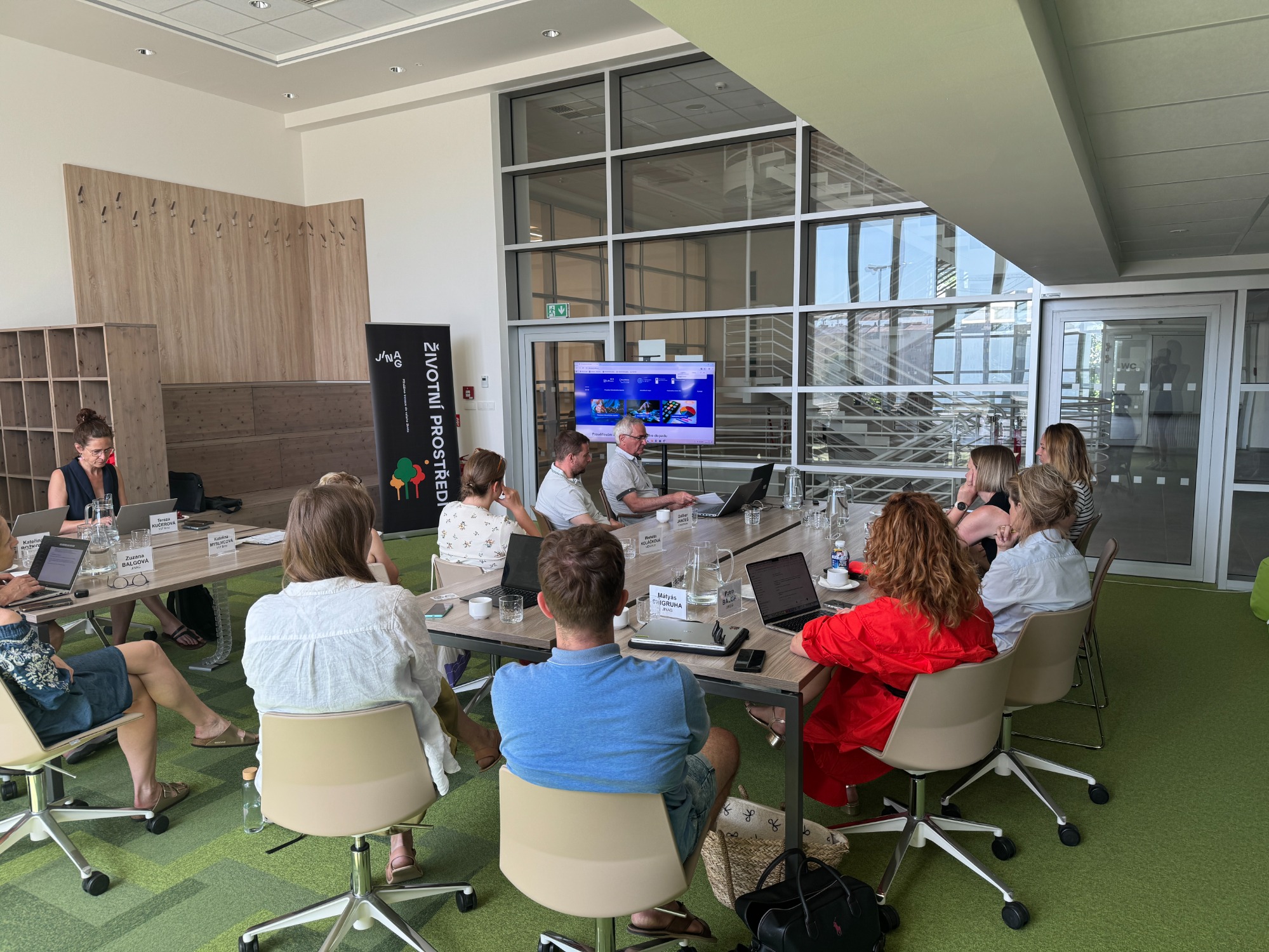
Representatives from the South Moravian Region and universities had the opportunity to familiarize themselves with the application at a hands-on workshop we organized on June 23 in Brno. Pavel Zahradníček and Dalibor Janouš from the Global Change Research Institute of the Czech Academy of Sciences (CzechGlobe) provided a detailed practical demonstration of the entire system.
Participants didn’t just stick to theory. During the program, they walked through the entire process of working with the tools—from locating a project on a map to downloading climate data to the actual assessment of climate risks. In the second part of the workshop, they worked in groups on specific model projects to test how the application can be used in practice.
The workshop took place as part of the GreenGov project, funded by the Interreg Europe program. The project focuses on green financing and better application of sustainability principles in public investment decision-making.
Green financing is not just about money
Green financing does not merely mean seeking new sources of funding. It also means making responsible decisions about which projects should be supported with public or European funds.
Climate proofing helps with this in very concrete ways. It shows whether the planned infrastructure is resilient to the impacts of climate change or could become unnecessarily vulnerable, expensive to operate, or costly to repair in just a few years. As a result, climate proofing becomes more than just a formal attachment to an application; it becomes a tool for better decision-making.
Benefits for Applicants and Everyone Who Wants to Build Responsible
For applicants seeking European or national grants, the new applications offer significant simplification. Thanks to them, climate assessments can in many cases be prepared online, using available data and without having to wade through complex methodologies
But their benefits extend beyond grants. ClimRisk.cz and ClimateProofing.cz can also serve as practical tools for municipalities, designers, investors, or private builders who want to know what climate risks to anticipate for their projects
Climate risk assessment is thus not just a formal attachment to an application. It is a tool that helps make better decisions even before construction begins
More information about the application: https://www.climateproofing.cz/ and https://www.climrisk.cz/